LONGWOOD COLLECTIVE NAMED BOSTON CLIMATE ACTION PLAN COMMUNITY PARTNER
Recognition honors the Collective’s “forward-thinking leadership” in climate resilience and sustainability across the Longwood Medical and Academic Area
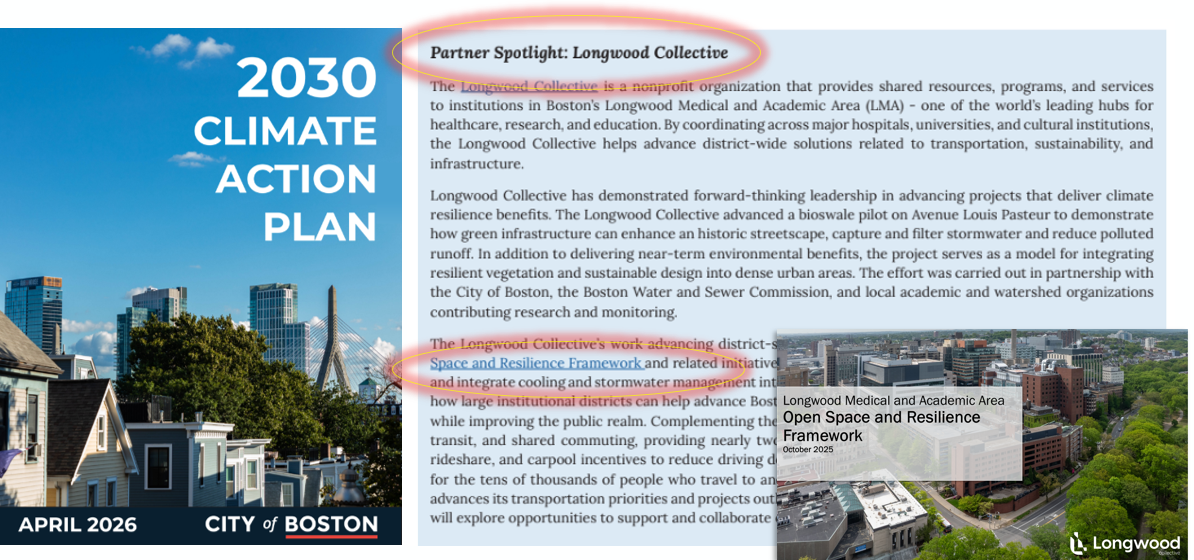
BOSTON – Tuesday, May 5, 2026 - The Longwood Collective, the chief planner and principal steward of the Longwood Medical and Academic Area (LMA), has been recognized as a Community Partner by the City of Boston for its role in implementing key elements of the City’s new Climate Action Plan (CAP).
The CAP provides a roadmap for how the City will achieve its carbon emissions reduction and climate resilience goals, including reducing community-wide greenhouse gas emissions by 50 percent by 2030 and reaching carbon neutrality by 2050.
The Collective is one of 31 Boston organizations to receive the Community Partner designation, which the City said recognizes the Collective’s “forward-thinking leadership in advancing projects that deliver climate resilience benefits.’’ The CAP highlights the Collective’s recently adopted Open Space and Resilience Framework, which includes initiatives to expand tree canopy, deploy green infrastructure, and integrate cooling and stormwater management into open space and streetscape improvements.
Longwood Collective’s President and CEO, David Sweeney, said, “Advancing climate resilience is central to Longwood Collective’s mission and day-to-day work. Through initiatives like our Open Space and Resilience Framework, we are proud to help deliver on the City’s Climate Action Plan and are honored to be recognized as a Community Partner in that effort. Together, we are advancing practical, on-the-ground solutions that reduce emissions, strengthen infrastructure, and support the people who come to the LMA to work, learn, and heal.”
Abby Oliveira, the Collective’s project manager who led the development of the Open Space and Resilience Framework, added “We are encouraged by the strong alignment between the Climate Action Plan and our shared vision for a more resilient, sustainable, and equitable city. We look forward to continued partnership with the City to advance projects that protect and enhance the environment in the LMA and across Boston.”
Additional examples of the Collective’s leadership in decarbonization and resilience include:
- Transportation programs that make biking, transit, and walking safer and more reliable for the 73,000 employees and 24,000 students who travel to and through the 213-acre district every day. These include the LMA Shuttles connecting nearly 2 million riders annually to MBTA transit lines, Bluebikes stations and discounts, and ridesharing and carpool initiatives.
- Development of a bioswale on Avenue Louis Pasteur, in partnership with the City of Boston and the Boston Water and Sewer Commission, to capture and filter stormwater, support resilient plantings, and reduce polluted runoff – while replacing aging trees to strengthen tree canopy and carbon absorption.
- Planning a comprehensive approach in line with the City’s best practices to expand tree canopy and natural cooling across the LMA, including replacing traditional tree grates with permeable pavers and piloting green roof bus shelters with planting in locations where new trees are not feasible.